Your Audience Isn’t Gone.
It’s Drifting.
Editor’s note
This essay outlines the core mental model behind Audiencely’s Audience Health framework and informs how metrics like drift, escape rate, and core audience churn are interpreted.
For years, creators were taught a simple story:
Build followers.
Post consistently.
Reach will compound.
That story no longer matches reality.
Today, creators do everything “right” and still experience:
- Sudden drops in reach
- Videos that die instantly
- Followers who seem to vanish
- Engagement that feels thinner and less predictable
The common explanation is vague:
“The algorithm changed.”
But that explanation isn’t useful — and more importantly, it’s incomplete.
What’s actually happening is more subtle, more systemic, and harder to see:
Your audience isn’t disappearing.
It’s drifting.
The shift creators weren’t told about
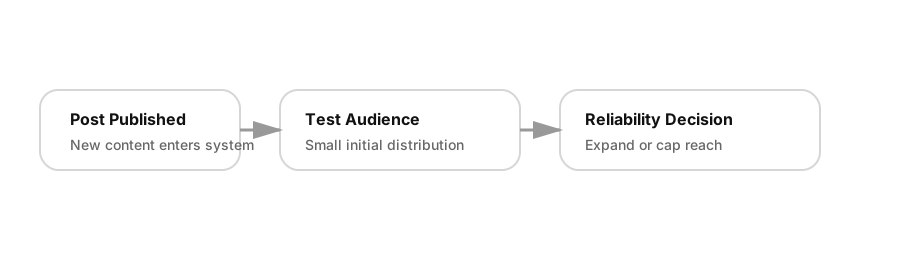
Short-form platforms no longer distribute content primarily through follower graphs.
They distribute content through interest testing systems.
Every post is:
- Shown to a small test audience
- Evaluated for consistency of response
- Either expanded or quietly capped
Followers matter far less than they used to.
Predictability matters far more.
This means creators no longer “own” reach — they earn it repeatedly, post by post.
The problem is not that creators don’t understand this shift.
It’s that they can’t see its effects clearly.
Why analytics stopped being helpful
Most creator analytics answer questions like:
- How many views did this get?
- How many likes?
- How many followers gained?
Those numbers describe outcomes, not systems.
They tell you what happened, not:
- Why it happened
- Whether it’s getting better or worse
- Whether it’s a one-off or a trend
By the time views drop enough to be obvious, the underlying problem has usually been present for weeks.
Creators sense this intuitively:
“Something feels off — but I can’t tell what.”
That feeling is not paranoia.
It’s a lack of visibility.
Audience drift: the hidden failure mode
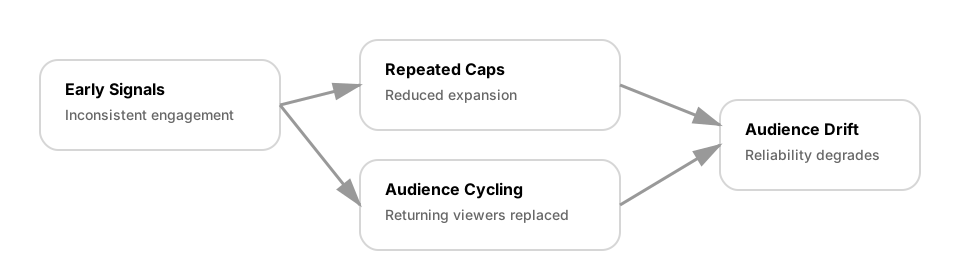
Audience drift happens when:
- The people engaging with your content change faster than the platform can stabilize distribution
- Returning viewers are quietly replaced by transient ones
- Early engagement becomes less predictable, even if totals look fine
This creates a dangerous illusion:
- Views may hold steady for a while
- Follower count may continue growing
- But the reliability of reach degrades underneath
Eventually, creators experience:
- Inconsistent performance
- Sudden “dead” posts
- Flat or fragile growth
At that point, most creators assume:
“My content stopped working.”
In reality, the system lost confidence in who your content is for.
How drift forms (a simple model)
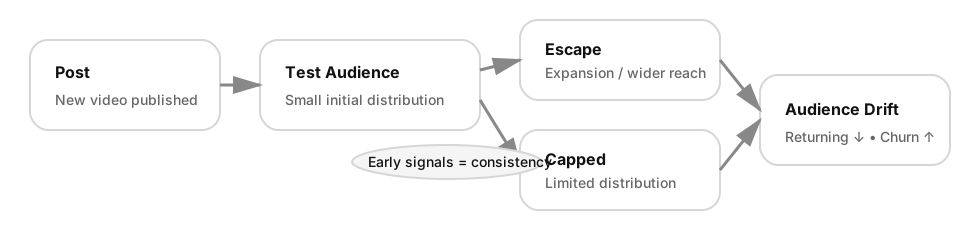
This is the loop most creators never see:
- A post enters a test audience
- Early signals determine whether distribution expands or caps
- Repeated caps reduce distribution confidence
- Reduced confidence accelerates audience drift
Drift is not a punishment.
It is a signal instability problem.
Why posting more often makes it worse
One of the most common reactions to declining reach is to post more.
This feels logical:
More attempts → more chances → more data
But during audience drift, increased posting often accelerates the problem.
Each post introduces new signals.
If those signals are inconsistent — even subtly — the system struggles to identify:
- Which audience cluster should see the content
- What response to expect
- Whether expansion is safe
Posting more during instability increases uncertainty.
This is why creators often say:
“I tried harder and everything got worse.”
They weren’t doing the wrong thing — they were acting on incomplete information.
Escape is not virality
When a video reaches beyond its initial test audience, creators often describe it as “going viral.”
But virality is the wrong mental model.
What’s actually happening is escape:
- The platform decides the content is reliable enough to show to a broader audience
- Not because it’s clever
- But because its early response was consistent and interpretable
Escape is about trust, not popularity.
A small, predictable group reacting strongly is often more valuable than a large, noisy group reacting weakly.
Creators who misunderstand this chase novelty.
Creators who understand this prioritize clarity.
Core audiences don’t leave loudly
Another illusion creators face:
“If my core audience left, I’d notice.”
In reality, core audience churn is quiet.
It looks like:
- Familiar commenters appearing less often
- Engagement ratios thinning slightly
- Posts feeling less “warm,” even when views are similar
By the time this becomes obvious in analytics, the relationship has already decayed.
This is not an algorithmic punishment.
It’s a relationship mismatch.
The real problem creators are facing
Creators don’t lack effort.
They don’t lack creativity.
They don’t lack discipline.
They lack decision context.
They don’t know:
- Whether what they’re seeing is normal
- Whether it’s temporary or structural
- Which changes are low-risk vs irreversible
- When to experiment — and when not to
Most creator tools try to solve this by giving advice.
That often makes things worse.
What creators actually need is:
- Explanation
- Constraints
- Tradeoffs
- Early warnings
They need to know what kind of problem they’re in before trying to fix it.
A different way to think about reach
Instead of asking:
“How do I grow?”
Creators need to ask:
“How reliable is my audience right now?”
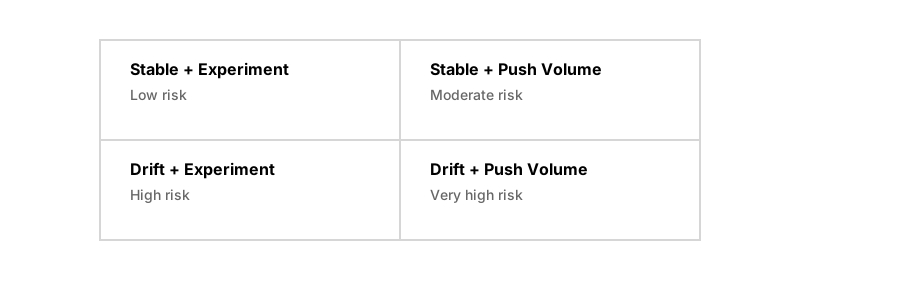
Audience reliability determines:
- Whether experiments are safe
- Whether posting more helps or hurts
- Whether decline is likely reversible
This is what we mean by audience health.
Not growth.
Not virality.
Not optimization.
Health.
Why this matters now
The creator economy is maturing.
Platforms are:
- Saturated
- Incentivized to prioritize efficiency
- Less forgiving of uncertainty
Creators who succeed long-term will not be the loudest or fastest.
They will be the ones who:
- Understand system behavior
- Detect instability early
- Make fewer irreversible mistakes
The next era of creator tools will not be about telling people what to post.
They will be about explaining what’s happening underneath.
Where Audiencely fits
This framework is the basis for how Audiencely approaches audience health.
The goal is not to optimize content, but to make audience behavior and distribution reliability visible before decline becomes obvious.
It exists to:
- Detect early signs of audience drift
- Explain distribution reliability
- Give creators clarity before decline becomes obvious
Not to replace creativity.
Not to sell hacks.
But to make the invisible visible.
If this resonated
If you’ve felt:
- Confused by inconsistent reach
- Frustrated by shallow explanations
- Unsure whether to push forward or pause
You’re not alone.
And you’re not broken.
Your audience may not be gone.
It may just be drifting.