What drift is (and what it isn’t)
Audience drift is a gradual, compounding decline in repeat engagement and distribution stability. It shows up before total views collapse. Drift is not: - A single bad week - A verdict on content quality - An algorithm "penalty" you can reverse with one change
It is a pattern of weakening audience reliability across multiple signals.
How drift forms
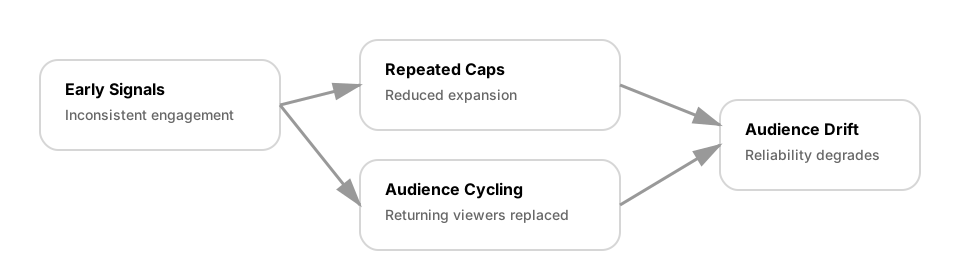
Short-form platforms test content quickly. When escape becomes inconsistent, the audience mix changes, and returning engagement thins out. Typical drift formation: - Test audience responses become less consistent - Escape rate starts to fluctuate - Reach expands unevenly (volatility rises) - Core viewers stop returning at the same rate
Over time, this compounds into a durable decline even if views appear normal early on.
Early warning signals (before views collapse)
Drift shows up first in stability metrics, not raw reach. The clearest early signals are: - **Returning Engagement Ratio (RER) declining ** - Core Audience Churn increasing - Escape Rate becoming inconsistent - Reach volatility increasing without stable escape
      If commenter exports are missing, RER and core churn are labeled as **Estimated / proxy**.
      "Something feels off, but the numbers still look fine."
Common misdiagnoses
Drift is often misread as randomness or platform changes. Common misdiagnoses include: - Treating volatility as viral opportunity - Over-indexing on one breakout post - Assuming a weak month means content failure - Attributing all movement to algorithm updates without checking internal drift
How Audiencely measures drift
Audiencely models drift as a stability problem across distribution and return behavior. We measure drift by: - Tracking RER and core churn (Measured or Estimated) - Scoring escape rate reliability over time - Separating reach volatility from true expansion - Surfacing confidence levels for each signal
We use these signals to establish **decision context**, not to prescribe content changes.