What this framework addresses
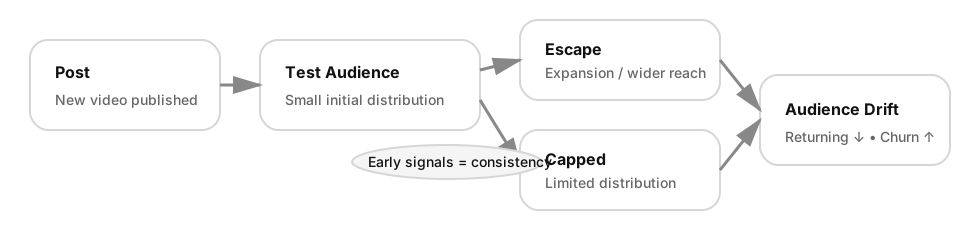
Audience Health explains whether your audience is still reliably finding, engaging with, and returning to your content. It separates normal short-term variability from early signs of drift by tracking signals that compound over time, not just single-post performance. Key signals include: - Escape rate consistency (how often posts leave the test audience) - Repeat engagement ratio (who comes back, and how often) - Core churn rate (how much of the core audience is slipping) - Reach quality (stable vs volatile expansion)
Why this problem is hard to see
Short-form platforms test content quickly and unevenly. That makes the feed feel random even when underlying patterns are changing.
Lagging signals add noise. Views might look fine while the composition of engagement shifts under the surface.
"My views dropped but I didn't change anything."
Common misinterpretations
Audience Health is often misunderstood as a single score or a verdict on content quality. It is not. Common mistakes: - Assuming a viral spike means long-term health - Treating one weak week as evidence of failure - Confusing novelty with stability - Attributing all changes to platform updates without checking internal drift
How Audiencely uses this framework
Audiencely combines multiple stability signals into a health state and explains why the state is shifting. In practice, we: - Compute a health score and state (Stable, Early Drift, Active Drift, At Risk) - Highlight the distribution and retention signals driving change - Show confidence levels for each signal - Map the findings to decision context without prescribing content
This keeps creators grounded in evidence before making changes.