What decision context means
Decision context is the state-based framing that determines whether a change is low-risk or high-risk right now.
It is not a recommendation engine. It is a way to interpret signals before acting.
In Audiencely, decision context is anchored to audience health state and how distribution behaves, not to a single post outcome.
Why metrics don’t translate into decisions
Most analytics are isolated measurements. They show what happened, but not what is safe to change. The same metric can mean different things depending on the surrounding state: - A flat Escape Rate can be stable in one state and fragile in another - A short-term reach spike can mask rising churn - A mild RER drop can be noise or an early drift signal
Without context, creators either overreact or do nothing.
Risk, reversibility, and timing
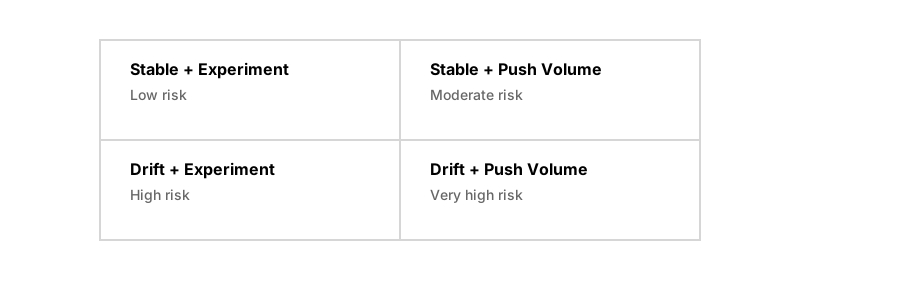
Decision context defines how reversible a change is and how much uncertainty you can tolerate in the current state. Signals that shape timing: - Distribution Reliability (Escape Rate) - Audience Stability (RER + Core Churn) - Reach Quality (volatility vs escape) - Trend direction (Improving / Flat / Declining)
The same action can be low-risk during Stable states and high-risk during Active Drift.
How Audiencely applies decision context
Audiencely ties decision context to the Audience Health state and the signals behind it. We: - Combine Distribution Reliability, Audience Stability, Reach Quality, and trend direction - Surface the risk posture implied by the current state - Highlight which signals are measured vs estimated
Audiencely does not optimize content. It explains audience behavior.